
For years, we’ve been talking here at Eleusinia about psilocybin and DMT as tools for chronic pain, while most of the industry was solely focused on their application in mental health and personal development. So when a study on psilocybin and chemotherapy-induced nerve damage landed in Science, one of the two or three journals on earth that can make a scientist cry tears of joy, we read it closely.
Here’s the short version: it’s a genuinely exciting finding, and a precise one. It’s also a narrower finding than the topic might suggest at a glance. It mentions prevention, not necessarily treatment, and that distinction matters most if you’re reading this because you or someone you love is already living with nerve pain from chemo.
What Chemotherapy-Induced Neuropathy Actually Is
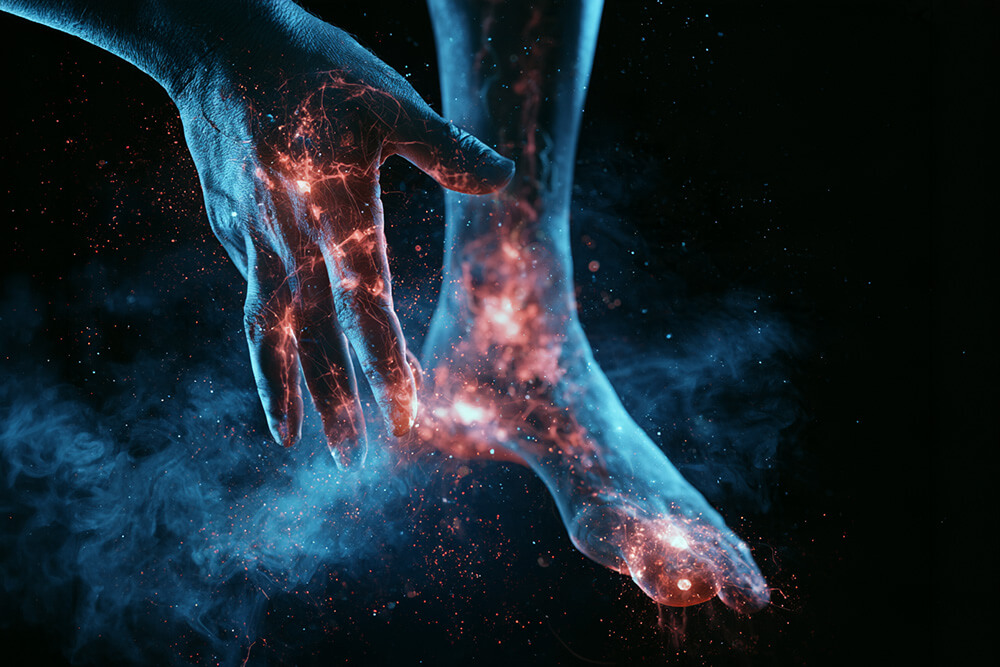
Chemotherapy-induced peripheral neuropathy, CIPN if you’d rather not say that four times, is one of the most common and least talked-about costs of cancer treatment. Platinum-based drugs like cisplatin and taxanes like paclitaxel are excellent at killing cancer cells and not terribly discriminating about the healthy nerve cells they damage along the way. The result, for a large share of patients, is burning pain, numbness, tingling, and a loss of sensation in the hands and feet that can range from annoying to disabling. It’s common enough to affect up to 60% of people on these drugs, and severe enough that it’s a leading reason oncologists have to reduce or stop otherwise life-saving treatment. The current standard of care is a drug called duloxetine, an antidepressant which isn’t even FDA-approved for this specific use and helps only modestly at best. Which is part of why a new mechanism is worth paying attention to.
What MD Anderson’s Psilocybin Study Found
Researchers at MD Anderson gave mice psilocybin before chemotherapy and found it prevented CIPN from developing in the first place, protection that held up across six consecutive chemo cycles over eight months, without blunting the chemo’s ability to kill tumors. Patrick Dougherty, one of the study’s senior authors, put it plainly: “This is the first time psilocybin has been used as a neuroprotective agent.” However, many citizen scientists, including us at Eleusinia, have been observing these benefits for quite a while. We’re excited to see science catching up and providing some insight into the mechanism behind it.
The protection wasn’t limited to one drug. It held across cisplatin, paclitaxel, and docetaxel, three different chemotherapy classes that damage nerves through different routes, which is a meaningfully harder bar to clear than protecting against just one. And the researchers didn’t stop at mice. They went on to confirm the same underlying biology in donated human nerve tissue, lab-grown human sensory neurons, and skin biopsies from actual cancer patients, so this isn’t a finding that only makes sense inside a mouse cage. Given that no pharmaceutical currently on offer does more than modestly dull CIPN’s debilitating symptoms once it shows up, a strategy aimed at preventing it in the first place is a genuinely different category of good news.
A detail worth sitting with: the mice were not microdosed. Nobody handed them a gentle, barely-there dose and hoped for the best. The researchers used what they describe as a robust, centrally active dose, the kind that reliably produces the classic rodent signature of a full psychedelic experience. Science hasn’t progressed to the point where we can ask a mouse if it’s tripping and get a clear, concise answer, so researchers rely on watching for a telltale head twitch instead. Two full doses, one before chemo started and one before a later cycle, were enough to fully protect the animals. A single dose before chemo only produced partial results.
Here’s the detail that made us sit up a little straighter: the researchers also tested a related synthetic compound called tabernanthalog, engineered specifically to activate the same receptor without producing the head twitching that gives a tripping mouse away. It worked. Similar protection, calm mice, no telltale twitch. That’s a real hint that even lower-intensity version of this protection might eventually be possible without the full intense trip attached. However, it is worth noting that a similar dose of tabernanthalog has been anecdotally been reported to produce at least mild psychedelic effects in humans, but formal human studies are lacking.
The anecdotal reports from people who’ve gone ahead and tried it themselves are, unsurprisingly, a mixed bag, some insist it’s trip-free, others describe something that sounds a lot like a trip. Nobody has done the careful work to find out whether a lower, gentler dose of psilocybin itself would hold up the same protection in a person actually facing chemo. And we are not going to be the ones to suggest you find out by trial and error. Nerve damage from chemo can be permanent. A few intense hours are not the thing to be afraid of here in comparison to a lifetime of nerve damage.
Here’s a fun thought worth sitting with: it’s entirely possible someone has already stumbled into this exact protection without ever knowing it. Psilocybin use isn’t rare, and if someone happened to take a real, full dose in the days around a chemo infusion, for reasons that had nothing to do with their nerves, they could have walked away protected from a lifetime of burning pain and never had any way to connect the two. It’s a interesting thing to consider: the exact protection researchers just spent years proving in a lab may already exist, quietly, in someone’s medical history, unrecognized.

If You Already Have Chemo-Induced Nerve Damage, Read This
Here’s the part we most want to get right, because it’s the part that matters most to the people who actually walk through our doors. This study is about prevention. It’s about giving psilocybin before nerve damage happens, to stop it from happening at all. Almost none of our guests come to us that way. Most arrive months or years after chemotherapy is over, already living with the numbness, the pain, the loss of sensation, looking for relief from damage that’s already been done. They often find valuable relief with psilocybin.
So does this study have anything to say to you? Directly, no. But we don’t think that’s the end of the story, and here’s why.
A separate study, this one looking specifically at pain that’s already become chronic, found something worth knowing: psilocybin relieved pain-like symptoms in mice with an already-established nerve injury, and it did so by changing activity in a brain region involved in how pain is processed and emotionally weighted, not by healing the nerve itself. The researchers confirmed the original injury was still physically there. The animals just stopped responding to it as though it were painful.
That’s almost certainly closer to what’s happening with our guests. Not nerve regeneration. A nervous system that’s relearning how to process sensations that are already there. Different mechanism, same receptor family, same reason we’ve believed in this for years. If you already have CIPN, the message isn’t “the science didn’t catch up in time for me.” It’s that the science is starting to explain two different processes with psilocybin in play, both prevention and relief, through two different avenues.
For what it’s worth, we’ve watched guests maintain neuropathy relief with psilocybin for years, not just for the length of a retreat. Many go on to use our Burst Pulse protocol, a process they learn during the retreat, on their own afterward as maintenance. That’s our own observation from running these retreats since 2021, not something any study has formally measured yet. We’d love for someone to.
Where the Psilocybin Research Goes From Here
A human trial, called NeuroGuard, is now testing exactly the question the mouse data raised: whether a lower dose can protect chemo patients from nerve damage as well as a full one. Dr. Moran Amit, who co-led the original study, said it best: a lower exposure might offer comparable protection with less intensity, and make this far easier to actually use in everyday oncology care.
It’s worth being specific about exactly what “easier to use” means there, since it’s a matter of oncology logistics, not anything about the nerve protection itself. A full psychedelic dose in a clinical setting means a supervised, multi-hour session, a dedicated space, staff trained for exactly this, and the liability of monitoring someone through a genuinely altered state, all of it expensive and hard to schedule across a hospital treating chemo patients back to back all day. A dose that skips the trip skips that entire cost structure too. That’s a real problem worth solving if you’re trying to treat thousands of patients a year in the most time and cost efficient manner.
It’s also a different calculation than the one we’re making here in a retreat setting. For a hospital, the psychedelic experience is the expensive, hard-to-schedule part, the thing you’d engineer around if you could. At Eleusinia, the experience itself also one of the main reasons people come here in the first place. We’re not looking for the smallest possible dose that gets the job done, without requiring much from hospital staff. We’re looking for the most effective method. If NeuroGuard finds that a lower dose prevents nerve damage just as well, that’s good news for someone about to start chemo who genuinely wants to avoid a psychedelic experience. But for someone facing a potential lifetime of nerve damage, chasing the minimum dose that might have a chance of working is a high stakes gamble. Undershooting doesn’t just mean a avoiding a psychedelic experience, it could mean a lifetime of consequences from a missed opportunity.
On a side note, you may find out that there’s a truly amazing feature of a full psychedelic experience that can provide benefits that weren’t even on your radar. You know those psychedelic effects that are being treated as “pesky side effects” in these studies? Well, they are pretty well known to be significantly beneficial for other cancer related symptoms, like anxiety, depression, and existential distress.

Deeper Technical Dive: How Psilocybin Protects Damaged Nerve Cells
Nerve cells, especially the long ones running from your spine to your fingertips and toes, depend on a delivery system to keep their farthest reaches supplied with energy. Mitochondria, the cell’s power plants, get physically hauled out along the length of the nerve by a motor protein called kinesin, riding along tracks made of microtubules. Chemotherapy drugs damage those tracks and starve the far end of the nerve of power, which is a major reason nerve endings in the hands and feet die back and stop working properly.
Psilocybin, once converted in the body to its active form, activates the 5-HT2A receptor on these nerve fibers, which sets off a signaling cascade that releases parked mitochondria and gets the delivery trucks moving again. The researchers found this held true down at the cellular level in real human nerve tissue and lab-grown human sensory neurons, not just mice, though whether it holds up in a living, breathing human patient is exactly what NeuroGuard is now testing.
Separately, and centrally, psilocybin also appeared to normalize brain activity that chemotherapy disrupts, a second, independent line of protection layered on top of the first. Two different jobs, one receptor, which is a big part of why this molecule keeps showing up in places researchers didn’t expect it to matter.
Read more about our Burst Pulse dosing protocol and how we think about psilocybin and DMT for pain here.
One Important Footnote
Since this article touches on cancer and psilocybin, there’s one important footnote to mention. Psilocybin has generally been safe and well tolerated in numerous studies related to cancer, but that doesn’t mean it’s safe or recommended in every case. It’s a conversation anyone considering it should have directly with their oncologist.
Cancer isn’t one condition. It’s not even close. Tumors in different tissues don’t share much biology just because they’re all called “cancer.” In the context of cancer, the risks of different medications depend heavily on the features of the tissue affected, and there are some rare and aggressive forms of cancer, particularly glioblastoma and DMG, for which avoiding serotonergic medications, psilocybin included, may be recommended.





2 Responses
You’re doing such important work, my friend! xo
Great stuff, Jessica