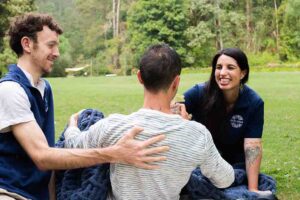
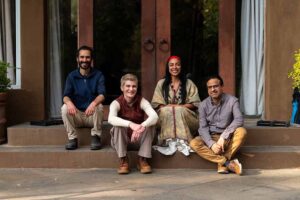
One evening during our eight day retreat, guests sit down to an eight course dinner.
Before the first plate arrives, we remove one thing.
Sight.
This is not performance. It is not theater. It is practice.
Throughout the week, we explore how perception is constructed. Neuroscience shows us that the brain is not a camera recording reality. It is a prediction engine. Every sight, sound, and sensation is filtered through expectation, memory, and belief.
We do not passively experience the world. We actively create it.
The Dinner in the Dark is where this idea becomes tangible.

Predictive Processing, on Your Plate
When you can see your food, your brain makes immediate predictions. Color suggests flavor. Shape suggests texture. Presentation suggests complexity. Before the first bite, your nervous system has already decided what is coming.
In darkness, those predictions weaken.
A creamy texture might belong to something savory. A familiar aroma might lead somewhere unexpected. Temperature and sound become louder in awareness. The mind reaches for certainty and finds less of it.
And in that gap, something shifts.
Guests begin to notice how much of taste is expectation. How quickly the brain labels. How confidently it assumes.
This is neuroscience you can feel.
The Symbol Behind the Experience
Our retreat is built on a simple premise. Insight matters most when it is embodied.
It is one thing to understand predictive processing as a concept. It is another to feel your own mind searching for stability in the dark.
The dinner mirrors the broader arc of the week. Psychedelic experiences often soften rigid perceptual habits. They show participants that what feels solid is often flexible. That perception is dynamic, not fixed.
The blindfolded meal offers a grounded way to explore that same principle without intensity or abstraction.
It asks:
What changes when certainty disappears?
How does the body respond when control is reduced?
What becomes possible when we stop assuming we already know?
More Than a Sensory Exercise
This dinner represents what we stand for.
Science not as information, but as lived reality.
Curiosity over assumption.
Direct experience over explanation.
When the blindfolds come off, guests do not just see their plates for the first time. They see their own perception more clearly.
And that is the point.