

It’s a quiet question, but an important one.
You might be considering a retreat and wondering whether it’s worth the investment. Not just the money, but the time, the travel, and the willingness to step into a deeply unfamiliar state of mind.
Or maybe you’ve already tried psilocybin and walked away thinking:
“That was it?”
No depth. No shift. Nothing lasting.
Or worse:
“Did I do something wrong?”
“Is this overhyped?”
When people say “psilocybin didn’t work,” they’re usually describing one of three very different situations:
Nothing happened at all
Something happened, but nothing changed afterward
Something changed, but it didn’t last
Each of these has a different explanation.
And in most cases, each of them can be understood and adjusted for with the right conditions and experienced, scientifically grounded guidance.
Why Didn’t I Feel Anything on Psilocybin?
Short answer:
If you felt nothing from psilocybin, the most common causes are biological, such as medication interactions (especially SSRIs), or dose calibration issues. Sometimes psychological factors such as strong cognitive control are in play. When a session falls short, there are usually identifiable factors that can be adjusted for.
If you felt nothing at all, it’s natural to assume something went wrong.
That’s a fair instinct.
But in most cases, when it appears to fail, there are identifiable factors at play.
What “structured” actually means
When we refer to a controlled or structured setting, it’s easy to picture something clinical—an indoor room, minimal stimulation, tightly managed conditions.
That’s not what we mean.
Structure is not about removing the environment. It’s about having the right expertise guiding the experience.
At Eleusinia, sessions are held outdoors, in a garden setting. The environment is open, natural, and intentionally designed to support the experience rather than restrict it.
What provides the structure is the presence of experienced facilitators grounded in medical science, not intuition or guesswork.
Why expertise matters just as much as the environment
The most important element of a structured environment is not only the space itself, but the people guiding it.
Psychedelic experiences can vary widely depending on factors like medications, individual biology, and how the experience unfolds moment to moment. Navigating those variables requires more than intuition.
It requires a working understanding of the underlying biology.
Medical professionals are uniquely positioned in this regard. While psychedelic facilitation is not something typically taught in medical or nursing school, the foundational knowledge is. When that background is combined with specific training in psychedelic work, it allows for a level of precision and safety that is difficult to replicate otherwise.
Not all medical professionals are trained in this area. But when they are, they provide a level of structure that goes far beyond the physical setting.

The most common cause: medications (SSRIs and antidepressants)
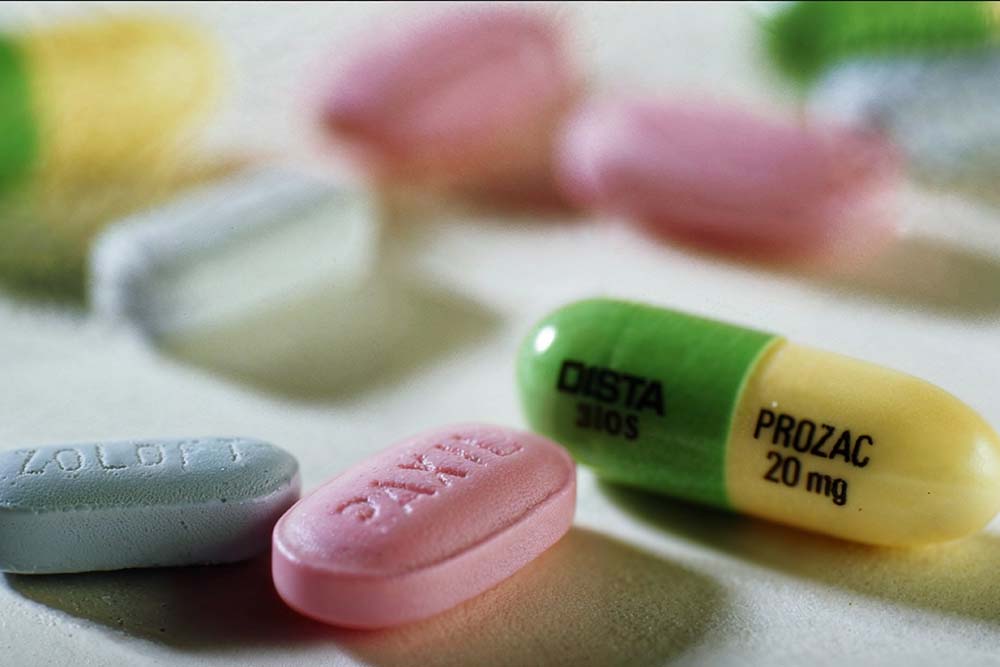
Certain medications, especially SSRIs and other antidepressants, can blunt or block the effects of psilocybin. This is the most common reason people report feeling nothing.
What makes this challenging is that it’s not a simple equation. Increasing the dose is not always the right solution, and adding a booster later is only effective within a narrow window during the session. Even among people taking similar medications, the degree of blunting can vary significantly.
This is where experience matters, because the margin between ineffective and excessive is not linear.
While there is no known toxic dose of psilocybin, overshooting is not without risk. The concern is not physical toxicity, but the intensity of the experience itself. A dose that is too high for a given individual can lead to an overwhelming, disorienting, and in some cases distressing or even traumatic experience.
Precision here is not just about effectiveness. It’s about avoiding unnecessary intensity that doesn’t serve the outcome.
This is why dose calibration often requires more than one session.
Is dose the problem?
Dose variability becomes a real issue in less controlled environments without professional support.
In recreational settings, people are often working with mushrooms of unknown origin, uncertain potency, or degraded material that has lost strength over time. Even when the dose is measured, the actual active content can vary widely.
In contrast, when working with known material in a controlled setting, dose becomes far more predictable.
Individual variation still exists, but it’s manageable. When handled properly, dose alone is rarely the reason for a complete lack of effect.
Can your mindset block psilocybin?
In some cases, yes.
Some individuals are highly skilled at maintaining control over their internal state. They can direct attention, manage distractions, and keep their thinking structured. These are valuable abilities in everyday life, but in a psychedelic context, they can limit how fully the experience unfolds.
For some people, the challenge is not access, but letting go of control long enough for the experience to emerge.
This isn’t a flaw. It’s a pattern. And like most patterns, it can be worked with over time.

Common myths that create confusion
When nothing happens, a few explanations tend to circulate: that the mushrooms were weak, that it simply doesn’t work the first time, or that it just doesn’t work for certain people.
These explanations are often used when the underlying biology isn’t well understood by the individual giving them.
They turn a solvable problem into a mystery and often leave people blaming themselves instead of identifying what actually needs to be adjusted.
A more precise way to dial this in: DMT
We begin with a psilocybin macrodose to establish a baseline. For most people, that’s enough to understand how their system responds.
But for those who feel little or nothing in that first session, we need a faster way to clarify what’s happening.
This is where DMT becomes useful.
Rather than starting with it, we introduce DMT after the first psilocybin session. Starting with DMT can be unnecessarily intense without context, but after an initial experience, it becomes a highly effective tool, especially for those who felt left behind.
Because DMT is short-acting and immediate, it provides a much clearer signal of how responsive someone is to serotonergic psychedelics. Instead of waiting multiple sessions to understand what’s happening, this allows us to compress that feedback loop and calibrate subsequent sessions with far greater precision.
Key takeaway
If nothing happened, something interfered.
The goal is not to guess, but to identify the variable and adjust it with precision, often across more than one session.






3 Responses
Thanks Jessica, I’m very much looking forward to joining you and your team in May. One question, what is SSRI’s? Cheers Doug
Jessica, I really appreciate your continuous informative emails the past few months. The articles about the experience, setting and professional guidance have been helpful to triangulate information as a preface to the retreat experience. I have become much more comfortable and confident with my decision to join the retreat later in 2026. Thank you, Chris
This is my first time to check in since the retreat I attended in March. The title caught my eye because I’m now thinking about sending my daughter and later my son so they can have this amazing experience too. I’ll be introducing them to you, Jessica, in the next few months so they can begin preparation. Best to you and the team. And by the way, I’m already contemplating when my next retreat will be—there’s so much to learn! —Ben