I’m the founder and program designer of Eleusinia. I’ve personally experienced psilocybin macrodoses more than 100 times, and I’ve overseen thousands of sessions at the retreat.
That’s not a brag. In this field, people sometimes count psychedelic experiences like notches on a belt and attach meaning to the number itself. That’s not what this is.
The reason I’ve had that level of exposure is more practical. I have a neurological condition that I’ve managed through repeated sessions, which means I’ve had to return to the experience consistently over time. And when you do that, you don’t get to assume every session is going to cooperate.
So I’m going to be direct.
What people call a “bad trip” does happen. And when it does, it can take on a very specific form. The best way to describe it is psychedelic terror.

It’s not subtle. It’s not abstract. It’s a state where fear feels immediate, convincing, and difficult to step outside of in the moment.
I’ve seen someone go from calm and curious to absolutely convinced something was terribly wrong within minutes, with nothing in the external environment changing at all.
On the other end of the spectrum, there’s psychedelic euphoria. A sense of clarity, connection, and emotional openness that can feel just as real and just as immersive.
Both of these states come from the same underlying process. You don’t get one without accepting the possibility of the other.
Most of the confusion around “bad trips” comes from not understanding what’s actually happening when an experience shifts in one direction or the other.
In this article, I’m going to break that down clearly.
We’ll look at:
- what a “bad trip” actually feels like
- why these experiences happen in the first place
- what conditions tend to increase the risk
- how to reduce that risk meaningfully
- what actually helps in the moment if things become difficult
- and how to approach future sessions after a challenging experience
I’ll also share some patterns I’ve seen repeatedly, along with a few specific examples from real sessions.
What People Mean by a “Bad Trip”
When people talk about a “bad trip,” they’re usually not describing a single, clearly defined experience. The term gets used loosely, and often inaccurately.
For some, it refers to moments of anxiety or emotional intensity. For others, it describes something much more overwhelming. A sustained period where thoughts feel out of control, fear becomes convincing, and the experience turns inward in a way that feels difficult to navigate.
In practice, what gets labeled a “bad trip” tends to fall into a few recognizable patterns:
- overwhelming anxiety or dread
- loss of perceived control over thoughts or emotions
- repetitive thought loops that are difficult to interrupt
- distorted sense of time, where the experience feels endless
- emotional flooding, where difficult material surfaces all at once
But underneath all of these variations, there is a more fundamental mechanism at play.
Valence is how much we are attracted to or repelled by a sensation.

Every thought, emotion, or physical sensation carries some degree of this. We’re either leaning toward it, or trying to get away from it.
At Eleusinia, we tend to avoid framing this as “positive” or “negative.” Instead, we describe it as high valence and low valence.
- High valence is associated with openness, connection, clarity, and what people often describe as psychedelic euphoria
- Low valence is associated with contraction, fear, resistance, and what people call a “bad trip” or psychedelic terror
The important point is that the underlying experience is not always as different as it seems. In many cases, the shift from what feels like insight to what feels like panic is not a change in content, but a change in valence.
It’s pretty common to see a person sitting in our garden during the session, just staring out in wonder, completely absorbed in the foliage or the movement of the clouds, tears of joy streaming down their face. During their internal phases, they may be reclining with an eye mask on, quietly smiling or even laughing to themselves at the flow of internal imagery and sensation.
The system is capable of producing that level of immersion and meaning.
The same system, under different conditions, can move in the opposite direction.

It’s easy to understand this concept while sitting comfortably, reading about it on a screen.
In real time, it’s a completely different experience.
You’ve never experienced anything stronger than your own mind, because every experience you’ve ever had comes from it. Under psychedelics, that system can amplify dramatically.
In states of extremely low valence, what people call a “bad trip,” the instinct is to move away from the experience as quickly as possible. The problem is that the experience is coming from within, which makes it difficult to escape in the usual ways.
One of the early indicators we often see when an experience is starting to go sideways is a subtle shift in behavior. A guest who had been comfortable outdoors may suddenly feel the urge to go inside. It’s an understandable move. Indoors can feel like a form of containment, a way to regain a sense of safety.
But in practice, that shift often makes things worse.
The confinement of four walls can intensify the sense of being trapped, and what started as an attempt to stabilize the experience can contribute to it snowballing further into low valence.
In theory, you could recognize what’s happening, label it, and allow it to pass.
In practice, that level of cognitive control is extremely difficult to access in the moment. It typically requires a great deal of training, and even then, it’s not always reliable under intensity.
For most people, this is where external support becomes important. Having someone who understands the process and knows how to intervene can make a significant difference.
On the other end of the spectrum, high valence states, what people describe as psychedelic euphoria or ecstasy, feel equally immersive, but in the opposite direction. There’s a sense of openness and connection that people tend to move toward rather than away from.
Both are part of the same system. The difference is how the experience is being felt in the moment.
Why Bad Trips Happen (The Underlying Mechanisms)
At a basic level, every experience we have carries some degree of valence. It can feel neutral, it can feel attractive, or it can feel repulsive.
Under normal conditions, that range stays relatively stable and manageable.
Psilocybin changes that.
It acts as a non-specific amplifier, meaning it doesn’t selectively enhance only certain types of thoughts or emotions. It increases the intensity of whatever is present in the field of experience, including subtle sensations that would normally go unnoticed.
Because every aspect of consciousness carries valence, amplification also increases how strongly we are pulled toward or pushed away from what we are experiencing.
This is where the snowball effect begins.
A small shift toward low valence can become more intense. That intensity can make the experience feel more urgent or threatening. That perceived threat increases resistance. And that resistance further amplifies the sense that something is wrong.
At a certain point, the content of the experience matters less than the loop itself. The system starts reinforcing its own reaction.
This is what most people experience as a “bad trip.”
At Eleusinia, we occasionally see how small that initial trigger can be.
A guest once insisted on keeping their smartwatch on during a session, despite our general guidance to leave electronics behind. What they didn’t realize was that Bluetooth was still connected to their phone in their room. At some point during the session, a message came through. It was completely mundane, a friend asking them to swing by their home to pick up a forgotten item.
Under normal conditions, it wouldn’t have registered as anything unusual. In that moment, it did.
The message interrupted the experience, and the guest became fixated on it. They were suddenly trying to reconcile how they could possibly respond or open the door for someone while they were physically in Mexico on retreat. The situation escalated quickly, not because of the message itself, but because of how it was being interpreted under amplification.
With redirection and support, the state passed and stability returned.
Importantly, this doesn’t require anything extreme to be present at the start. It can begin with something small, a passing sensation, a thought, a moment of discomfort, that becomes amplified and then interpreted in a particular way.
The system doesn’t need a big problem to react to. It just needs something to latch onto.
Changes in perception can work the same way.
Visual shifts, especially changes in color, are very common in a psychedelic state. They are often one of the more interesting and enjoyable aspects of the experience.
But they are not interpreted the same way by everyone.
A guest once looked down at their legs and saw a strong red cast to their skin. In another context, that same visual shift could have appeared green or purple. In that moment, it was interpreted as an allergic reaction.
Despite the fact that their skin was not actually red nor were they having an allergic reaction to anything, the interpretation was convincing enough to trigger distress and panic. With guidance and demonstration that this was a visual effect, the experience was redirected and the intensity subsided.
The environment plays a major role in how this unfolds.
When the surroundings fell hectic or lacking in support, the system is more likely to interpret amplified sensations as threatening. This tends to push valence in a lower direction and make it harder to recover once that shift begins.
Some common conditions that can contribute to this:
- Being alone without support
No external reference point to help regulate or reorient - Enclosed indoor environments
Limited space, no access to open views or movement, which can increase feelings of confinement. - Social settings with implicit pressure
A sense of needing to behave normally or perform while the internal experience is changing - Unpredictable or chaotic environments
Music festivals, public spaces, parties, or even primitive camping where attention is divided between the experience and external responsibilities.
These factors don’t guarantee a bad trip, but they increase the likelihood that a shift toward low valence will escalate rather than resolve.

At the same time, it’s important to be clear about something.
Even in well-prepared, structured environments, psilocybin remains a non-specific amplifier. That means it is still possible for an experience to move into intense low valence, even when the conditions are carefully designed.
The goal is not to eliminate that possibility entirely. It’s to reduce the likelihood of escalation, and to have a clear plan for how to respond if it does happen.
That’s where physical preparation, environment, and skilled support become critical.
Are Bad Trips Harmful?
The short answer is: sometimes, but not always. There is a spectrum.
One of the biggest sources of confusion is that the term “bad trip” gets used to describe very different types of experiences.
On one end, there are experiences that are intense, difficult, or uncomfortable, but ultimately meaningful. These can involve confronting challenging emotions, navigating uncertainty, or letting go of familiar patterns. They are not easy in the moment, but they often resolve in a way that feels constructive and productive.
On the other end, there are experiences that are fear-inducing, extremely disorienting, or persistently destabilizing, where the intensity escalates without resolution. These can feel more like sustained psychological distress than something that is being worked through.
Those two categories are not the same, and the difference matters.
As humans, we are capable of tolerating and even valuing difficulty. People run marathons, climb mountains, and willingly engage in experiences that are physically and mentally demanding. There is a sense of effort, challenge, and eventual reward.
That is very different from unstructured suffering, where the experience becomes chaotic, frightening, and disconnected from any sense of progress or meaning. That type of experience is more likely to be remembered as traumatic rather than transformative.
Psychedelic experiences can fall anywhere along this spectrum.
In most controlled settings, even difficult experiences tend to remain within a range that can be navigated and integrated. But when intensity escalates in an unsupported or unstable environment, the risks increase.
It’s important to be clear about where those risks come from.
Psilocybin itself does not have a known toxic dose in the way many other substances do. The primary risk is not chemical toxicity, but harmful behavior under altered perception.
In a state of high confusion or fear, especially in environments that feel unsafe or unpredictable, a person may make decisions that they wouldn’t otherwise make. That’s where the potential for physical harm enters the picture.
This is one of the main reasons that environment and support matter so much.
A structured setting with stability, and experienced guidance reduces the likelihood that a difficult experience will escalate into something destabilizing. It also provides a safety net if it does. At Eleusinia, this includes not only trained and experienced facilitators, a fully dedicated and purposefully curated space, but also access to medical professionals who are familiar with the process and able to respond if needed.
There is also an important nuance when it comes to outcomes.
Research suggests that challenging experiences are often associated with meaningful therapeutic benefit, particularly when they are properly supported and integrated. At the same time, experiences that are described as mystical or deeply connected, what we’ve referred to as high valence states, are also strongly associated with positive outcomes.
From our perspective, both ends of that range can be valuable.
The goal is not to eliminate challenge, or to chase only pleasant experiences. It’s to create conditions where intensity, whether it moves toward difficulty or euphoria, can be experienced safely, understood clearly, and integrated effectively.
What we aim to avoid is not discomfort, but unnecessary suffering, harmful destabilization, and trauma.
How to Avoid a Bad Trip

You can’t eliminate the possibility of a difficult experience entirely.
Psilocybin is a non-specific amplifier. That means intensity, including shifts into low valence, can still occur even under well-designed conditions.
What you can do is significantly reduce the likelihood that a moment of discomfort escalates into something overwhelming, and ensure that if it does, it can be managed safely.
That comes down to preparation, environment, and support.
Starting State: You Don’t Need to Be “Fine”
You don’t need to be in a perfectly calm or stable state to benefit from psilocybin.
Many people pursue this work specifically because they are dealing with anxiety, depression, or ongoing internal stress. That’s part of what the experience is designed to engage with.
It’s also important to recognize that everyone has a different baseline. For some people, a certain level of anxiety is a constant background condition. For others, it’s minimal. Neither of those starting points is inherently a problem.
The goal is not to wait until you feel “good enough.”
In a structured setting, even elevated stress or anxiety is something that can be actively managed.
At Eleusinia, our medical team is present throughout the entire retreat and has pharmacological tools available to help reduce acute anxiety when needed before any sessions. This allows the experience to begin from a more stable baseline, without requiring someone to resolve everything on their own beforehand.
Our environment, preparation process, and support structure are all designed to absorb that initial intensity and give it space to unfold without unnecessary escalation.
Understanding What’s Happening
A significant portion of escalation comes from misinterpretation.
If you don’t know that intensity, shifts in perception, and changes in valence are expected, those changes can be interpreted as something going wrong. That interpretation alone can push the experience toward low valence.
Understanding the mechanism doesn’t give you full control in the moment, but it reduces the chance that normal effects are mistaken for problems. At Eleusinia, our educational presentations, orientation and “pre flight instructions” focus on helping our guests understand these mechanisms.
Environment Design
The environment plays a direct role in how experiences are interpreted.
Spaces that are:
- personal
- stable
- curated
- free of external demands
are less likely to be perceived as threatening when intensity increases.
In contrast, environments that require social performance, navigation, or decision-making tend to increase pressure and make it harder to regulate the experience.
Access to Open Space
Physical space matters more than most people expect.
Open environments, especially those that allow for movement and wide, unobstructed views, can help regulate low valence states. Confinement, on the other hand, can amplify feelings of being trapped or overwhelmed.
This is not just aesthetic. It directly influences how the experience is processed.
Skilled Support (Including Medical Oversight)
Having someone present who understands the process is one of the most important protective factors.
This includes:
- recognizing early signs of escalation
- guiding attention and grounding
- helping reframe the experience in real time
In a structured setting, this also extends to the presence of medical professionals who are prepared to intervene pharmacologically if needed.
That layer of support significantly changes the risk profile of the experience.
Dosing Consistency and Predictability
One of the biggest variables in psychedelic experiences is unpredictability.
Using known material with an established psilocybin source allows for more consistent and targeted intensity. This reduces the chances of unintentionally exceeding the range that can be comfortably navigated.
The goal is not simply “more” or “less,” but predictable and appropriate intensity.
Early Redirection Skills
One of the most effective ways to prevent escalation is to intervene early.
Our guests are trained in redirection techniques that allow them to shift attention, reorient, and stabilize valence before a low-valence state begins to snowball.
This is important because once intensity builds, it becomes harder to influence.
These techniques also create multiple opportunities within a single session to practice letting go, not as an abstract idea, but as a skill that can be applied repeatedly under different conditions.
Reducing High-Risk Contexts
Certain environments consistently increase the likelihood of difficult experiences escalating:
- being alone without support
- enclosed or restrictive spaces
- social environments with pressure to behave normally
- unpredictable settings that require ongoing attention or responsibility
These conditions don’t guarantee a bad trip, but they remove many of the factors that help stabilize the experience when intensity increases.
Knowledge vs Guesswork
There is a difference between approaching psychedelic experiences with skill and knowledge, versus approaching them through trial and error.
Many people eventually move toward independent, self-directed work. The difference is whether that transition is made:
- with a clear understanding of the mechanisms
- with practical skills for navigating intensity
- with accurate information
or without those foundations.
Education and skill doesn’t eliminate risk, but it makes the experience far more navigable.
Having a Plan for Low Valence
Avoidance is only part of the equation.
Because psilocybin is a non-specific amplifier, it’s still possible for an experience to move into strong low valence even under ideal conditions.
What matters at that point is having a plan:
- knowing what to do
- knowing when to intervene
- having support available if needed
Reducing the likelihood of escalation is important.
Being prepared to respond if it happens is just as important.
What Actually Helps During a Difficult Experience
Difficult moments during a psychedelic experience are not unusual. What determines the outcome is not whether they occur, but how they are responded to.
The earlier a shift toward low valence is recognized, the easier it is to influence. As intensity builds, the range of available responses tends to narrow.
What helps is not trying harder to control the experience, but knowing how to respond to it as it changes.
Recognizing the Shift Early
Most difficult experiences don’t begin all at once. They build.
There is usually a point where something starts to feel tighter, more urgent, or more uncomfortable. Catching that shift early creates an opportunity to intervene before the experience snowballs into something harder to manage.
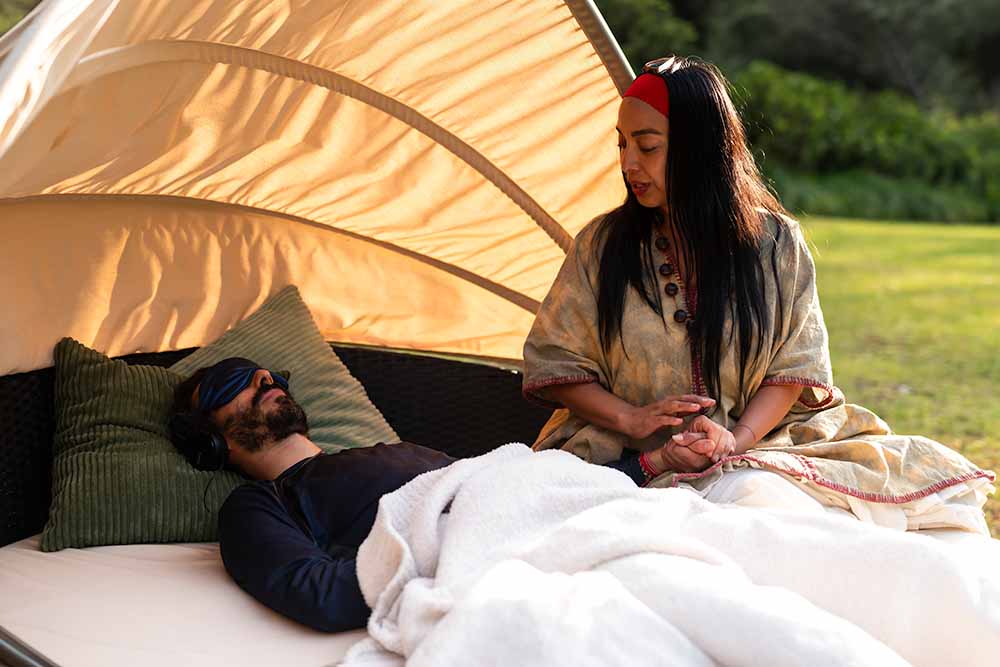
Redirection, Not Suppression
One of the most effective tools is redirection.
This involves shifting attention in a deliberate way:
- toward the breath
- toward the body
- toward a different sensory input
- toward the environment
The goal is not to suppress or avoid the experience, but to change the relationship to it.
Trying to “think your way out” of a low-valence state often makes it worse. Redirection works because it interrupts the loop without reinforcing it.
Environment as an Active Tool
The environment is not just a backdrop. It can be used actively.
Changing location, posture, or sensory input creates a reset point. It gives the system a new frame of reference and can shift how the experience is being interpreted.
Each change creates another opportunity to reorient.
For many people, it takes multiple rounds of:
- redirecting
- resetting
- and attempting to let go
before the experience shifts in a meaningful way.
This is normal.
A Real Example of This Process
A returning guest at the retreat, on her second visit, began her session in a strong high-valence state. The trees seemed to move rhythmically, the clouds shifted in color, and the overall sensation was light and euphoric. With her eyes closed, she described vivid internal imagery, colorful, spinning patterns that felt immersive and beautiful.
At some point, the experience shifted.
She began to feel that something was deeply wrong. There was no clear external cause, but the feeling was persistent and difficult to shake.
She tried changing her position, something that had worked for her in the past. We helped her move to a different part of the garden. We offered calming herbal support.
Each of these steps created opportunities to reset, but the sense of dread continued to build.
At the point where the experience crossed into true distress, our medical team intervened with anti-anxiety medication. This helped reduce the intensity and allowed her to settle back into a more manageable state.
Letting Go Happens in Stages
“Letting go” is often described as a single moment, but in practice, it usually isn’t.
It’s something that is attempted repeatedly, sometimes unsuccessfully at first, until the conditions are right for it to happen more fully.
Each attempt matters. Each reset creates another chance.
External Support and Guidance
When internal resources are not enough, external support becomes critical.
A skilled facilitator can:
- recognize escalation patterns
- normalize what is happening
- guide attention in real time
- help interrupt loops that are difficult to break alone
There is a difference between being accompanied and being guided. The quality of that guidance matters.
Reassurance Anchors
At certain points, a simple, stable reference can help reorient the experience.
One useful anchor is:
“This is the shuffle in progress. This is my conscious experience of the shuffle.”
This reframes the experience from:
“something is going wrong”
to
“this is the process unfolding”
That shift alone can influence valence.
Somatic Grounding
Bringing attention back to the body can help stabilize the experience.
- breathing patterns
- physical sensation
- contact with the ground or surroundings
These provide a reference point when thoughts become difficult to navigate.
Pharmacological Intervention (When Needed)
In some cases, the intensity exceeds what can be managed through redirection and support alone.
At Eleusinia, pharmacological tools are available to reduce acute distress and stabilize the experience.
The goal is not to suppress the experience unnecessarily, but to prevent escalation into destabilization or harm.
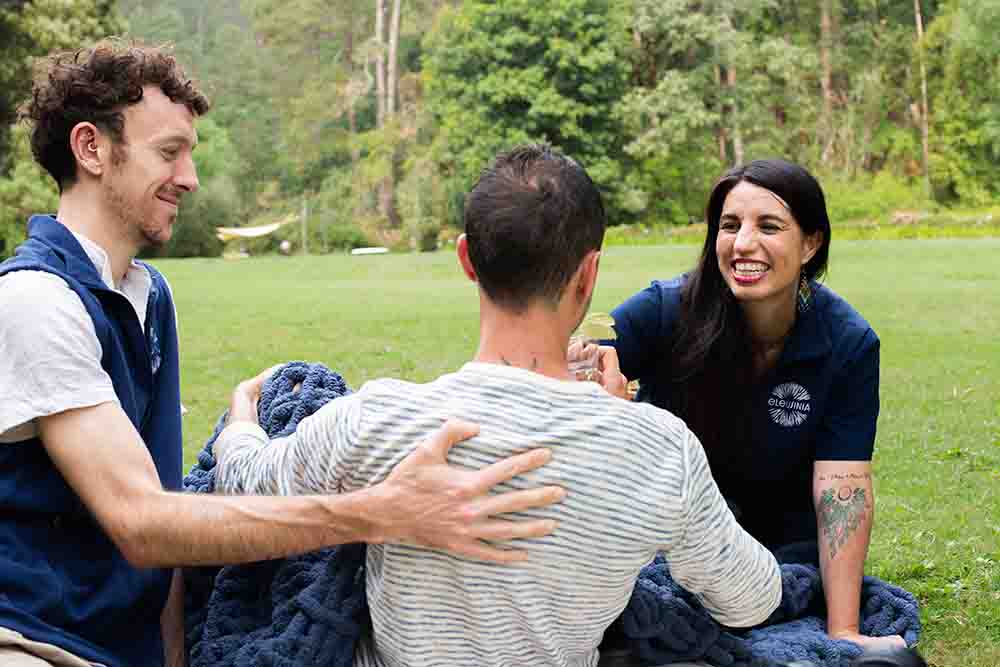
There Is No Single Point of Failure
A difficult moment is not a failed session.
There are multiple opportunities within a single experience to:
- redirect
- reset
- re-engage
What matters is not getting it right immediately, but having the tools and support to respond as the experience evolves.
How to Return to Psychedelic Work After a Bad Trip
After a difficult or traumatic psychedelic experience, it’s common to feel hesitant about returning.
For some people, the reaction is immediate:
“I’m never doing that again.”
For others, the interest is still there, but it’s mixed with a sense of caution or unease.
Both responses are normal.
A challenging experience can change how the brain relates to psychedelic states. The sensations themselves, the shift in perception, the changes in body awareness, can become associated with fear.

As a general principle: neurons that fire together wire together.
If psychedelic sensations were paired with anxiety, panic, or loss of control, the brain may begin to anticipate that those same sensations will lead back to the same place.
That doesn’t mean the door is closed. But it does mean the approach needs to change.
In my own case, I use psilocybin to manage a painful neurological condition. Notice the word manage, not cure. That means I have to return to the experience regularly to maintain relief.
This makes the relationship to the experience high stakes.
At one point, I had what most people would recognize as a true bad trip. Not just discomfort, but the kind of experience that leaves you shaken and with a strong aversion to even the idea of psychedelics.
Under normal circumstances, that kind of experience is enough to make someone walk away permanently.
In my case, that wasn’t an option.
There’s a natural cycle to my symptoms, and after a period of relief, they begin to return. So there was a window of time to rest and reset, but eventually I had to make a decision to re-engage.
Getting back into the experience was not easy.
It required approaching the next sessions differently, including premedicating with anti-anxiety medication to reduce the intensity of the initial response. Over multiple sessions, that allowed me to gradually re-establish a more stable and positive association with the experience.
This is the same general approach we use with guests who arrive after difficult or traumatic psychedelic experiences.
Not All “Bad Trips” Are the Same
The first step is understanding what actually happened.
There is a difference between:
- an experience that was intense and difficult, but ultimately meaningful
- and one that was fearful, persistently destabilizing, or traumatic
The recovery process depends on which category the experience falls into.
In both cases, the goal is not to dismiss or override what happened, but to understand it clearly and adjust the conditions moving forward.
Rebuilding the Association
One of the main challenges in returning is not the substance itself, but the association that has been formed around it.
If the brain has learned:
“these sensations lead to fear”
then encountering those sensations again can trigger the same response before the experience has a chance to unfold differently.
The process of returning involves retraining that association.
This doesn’t happen through willpower alone. It happens through:
- controlled conditions
- stable environment
- predictable support
- and repeated exposure to the same sensations in a different context
Over time, the brain begins to form new associations:
“these sensations can also be safe, navigable, and even positive”
Why Structured Support Matters
At Eleusinia, many guests arrive after having had a difficult or even traumatic previous experience.
What tends to help most is not simply trying again, but doing so in a setting where the variables are controlled.
This includes:
- a stable, private environment
- experienced facilitators
- and access to medical professionals
In some cases, pre-session medication is used to reduce acute anxiety, allowing the experience to begin from a more manageable baseline.
From there, the focus is on carefully guiding the experience so that the same sensations that were previously associated with fear can be encountered in a different way.
Gradual Re-engagement
Returning doesn’t have to mean jumping back into the same intensity immediately.
What matters is that the experience is:
- predictable enough to navigate
- supported enough to feel safe
- and structured enough to prevent escalation
Each session becomes an opportunity to rebuild confidence and re-establish trust in the process.

Avoidance vs Resolution
Avoidance is a natural response after a difficult experience.
But over time, it can reinforce the idea that the experience itself is something to fear.
Careful, supported re-engagement allows that pattern to shift.
The goal is not to force anything, but to create conditions where the experience can unfold differently.
When to Wait
There are also situations where it makes sense to pause.
If the previous experience remains highly destabilizing, or if there is no access to a safe and supportive environment, it may be better to focus on stabilization before returning.
Knowing when to wait is part of approaching this work responsibly.
A Different Approach, Not a Closed Door
A non-productive experience doesn’t mean psychedelics are not for you.
It usually means the conditions or support were not aligned in a way that allowed the experience to be navigated effectively.
With the right structure, it is often possible to return in a way that feels fundamentally different.
Not because the substance has changed, but because the context, the support, and the relationship to the experience have changed.
Conclusion: Understanding the Experience Changes the Outcome
What people call a “bad trip” is not a random failure of the experience.
It is usually the result of a predictable set of conditions:
- a shift toward low valence
- amplification of that shift
- and a feedback loop that escalates without interruption
The same system that produces psychedelic euphoria is also capable of producing psychedelic terror.
The difference is not the substance itself.
It’s how the experience is interpreted, supported, and responded to in real time.
Understanding this changes the equation.
It shifts the question from:
“Will I have a bad trip?”
to:
“How well is this experience being set up and supported?”
With the right environment, and guidance:
- the likelihood of escalation can be reduced
- difficult moments can be navigated more effectively
- and even challenging experiences can become meaningful rather than destabilizing
At the same time, it’s important to be realistic.
Psilocybin is a non-specific amplifier. Intensity is part of the experience, and it cannot be eliminated entirely.
What can be controlled is:
- how that intensity is introduced
- how it is supported
- and how it is responded to when it shifts
That is where outcomes are shaped.